Judge what deserves attention.
Assess research, new tools and provider claims. Explain which findings apply to your organisation, where evidence is weak and what needs testing.
The Scientist-Practitioner Programme
Bring scientific judgement into the way your organisation learns.
Develop the people who turn complex expertise into learning: from evaluating research and designing programmes to applying, studying and improving them in practice.
Joining on your own? Dates, fees and booking are on the open Scientific Trainer page.

A scientific capability inside L&D
Your organisation already has subject expertise, learning platforms and development programmes. This programme builds the capability to judge, design and evaluate how they are used.
Assess research, new tools and provider claims. Explain which findings apply to your organisation, where evidence is weak and what needs testing.
Translate complex knowledge into objectives, practice, feedback and workplace application. Give internal experts a method they can use repeatedly.
Define what success would look like. Collect suitable data and distinguish participant experience, learning, transfer and business outcomes.
The full development programme
Use research to improve practice. Use questions from practice to generate evidence. Qualification, ongoing development, continuing education and applied studies form one coherent pathway.
Outcome: a scientifically grounded learning concept and an evaluation plan.
Outcome: a continuing capability to investigate and improve your own practice.
Outcome: deeper expertise in the areas your work requires.
Outcome: findings and limitations that inform the next programme decision.
Build a corporate agreement around these components. The proposal specifies qualification, Masterclass participation, continuing-education access and any commissioned study. A full study is priced separately from the standard Masterclass fee.
Start with work that matters
Every participant brings a question of their own from inside the company. Four fields of work they tend to come from. For L&D teams, internal trainers, leadership and talent development, and scientific or technical experts who already develop others.

Strengthen the trainers who guide apprentices in their role. Design early-career programmes so that knowledge sticks and carries into daily work.
Possible evaluation focus: trainers' confidence in practice and learning progress in the first year.

Turn dense source material into an effective learning sequence. Connect explanations with practice, feedback and later retrieval.
Possible evaluation focus: knowledge retention and scenario performance.

Develop learning around approved AI tools, suitable tasks, source verification and human review.
Possible evaluation focus: task quality, critical errors and review effort.
Design development around observable behaviour and the organisational conditions that support its use.
Possible evaluation focus: behavioural feedback and workplace application.
From previous
participant projects
The neuroscience of storytelling in a pharma L&D context, and neuroscience-informed IT project management in the pharmaceutical sector. These are examples of project topics.
Final project day: present your learning concept, explain its scientific rationale and discuss the design and evaluation plan with peers and experts.
Voices from pharma and academia
Graduates from the pharmaceutical industry and professors who know the programme first-hand.

“This is what makes learning fun. The three-level perspective helped me bring my skills together into a business model with a clear thread running through it.”
Dr. Tobias Pfaller
Medicinal chemistry, pharma · Resilience trainer
Project in the Senior Scientific Masterclass: systemic project management based on the tetrahedron model, with a questionnaire instrument of his own.
Video statements
Scientific Trainer know-how in global deployments, training and change projects.
Deeper neuroscience-based work and a network that holds after the programme.
The Scientific Trainer background as a basis for corporate learning in the pharmaceutical industry.
Each YouTube video is loaded only after you click.
Academic references
“Highly suitable for anyone who genuinely wants to learn and is not afraid to engage with the natural sciences.”
Prof. Dr. Anke van Kempen
Professor of Research, Innovation and Transfer

“Highly recommended for anyone who wants to work on a scientific footing and to demonstrate the impact of their own work.”
Prof. Dr. Axel Koch
The Transfer Strength Method
Applied research and study delivery
What should change after your programme? Which data would show that change? Our research support connects the learning intervention with a feasible investigation and a clear account of what the findings mean.

Define the decision, outcomes and comparison. Choose a design appropriate to the question and practical constraints.
Select suitable instruments and test the collection process before committing to the full study.
Implement the agreed procedure. Analyse the data with transparent assumptions and appropriate methods.
Report estimates, uncertainty and limitations. Translate the findings into decisions about the learning programme.
Scientific guidance and a first supported pilot up to an initial trial data collection. Participants develop their own research capability.
Full implementation, instrument development where needed, data collection, analysis or project hosting are agreed and priced as a separate work package. Company responsibilities and data handling are defined in the scope.
Continuing education
Extend the programme with the specialist knowledge your team needs next.
The Scientific Trainer team
Dr. Franz Hütter, Nicolas Stege and Dr. med. Franz Sperlich bring complementary expertise to the Scientific Trainer qualification.
Programme lead
Dr. rer. medic., M.A. Neuroscience, psychology and science transfer. Doctorate on genetic determinants of empathy at the University of Duisburg-Essen; research and teaching at Essen University Hospital, and teaching in Applied Cognitive Neuroscience.
He leads the Scientific Trainer and the wider programme, and co-leads the Masterclass with Prof. Dr. Ulrich Lenz.

Evaluation and statistics
Scientific Trainer team member. Statistics, evaluation and instrument development, connecting practical questions with suitable measures and analyses.

Medicine and neuroscience
Scientific Trainer team member. Physician and trainer, contributing medical and neuroscience expertise to learning and development.
The extended programme team
Dr. Franz Hütter continues as programme lead. Together with Prof. Dr. Ulrich Lenz and Sandra Mareike Lang, he connects long-term scientific development with specialist AI expertise.
Masterclass co-lead
Co-leads the Senior Scientific Masterclass with Dr. Franz Hütter. Organisational development, leadership, change and the business value of L&D.

AI expert
AI across the extended programme: research, learning design, materials and practical workflows, with critical review of the results. Co-author of Neurodidaktik für Trainer.

The network behind it
A community of people from science, business and continuing education, and the lab in which the audit software is built. Awarded the German Demography Award 2022 in the category New Work Brought to Life.
New formats, methods and concepts are developed in the think tank before they enter the Scientific Trainer programme and the Masterclass. Membership is part of the Scientific Trainer programme and of the Masterclass.
Visit the think tank →Your corporate programme
Start with the people you want to develop, the work they need to improve and the questions you want to investigate.

Your proposal sets out the qualification, Masterclass participation, specialist education and any study deliverables, together with responsibilities, milestones and fees.
Entry to the Scientific Trainer requires at least two years of relevant professional experience. The current Masterclass pathway requires completion of the Scientific Trainer and TÜV qualification.
Personnel certification through PersCert TÜV is an optional addition to the standalone Scientific Trainer. The certification pathway can be included in your corporate programme. View scheme 0000081633.
To take with you
Nine pages: programme, curriculum, research support, references, team and scope. Ready to forward to procurement, business units and senior management.
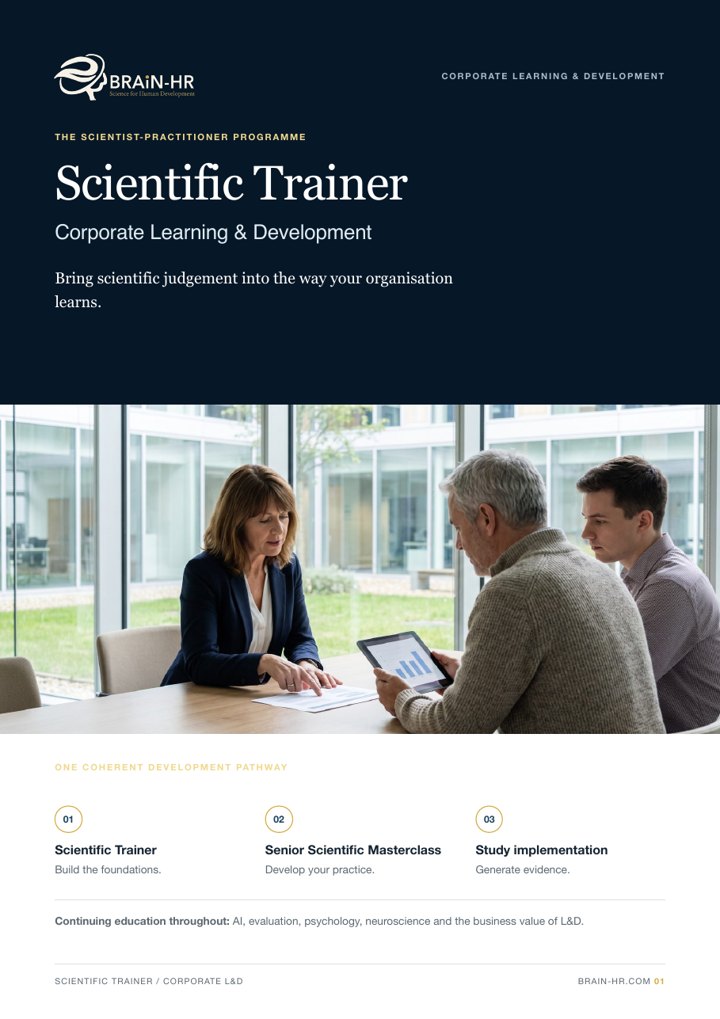
Scientific Trainer Corporate Learning & Development, 9 pages, PDF, 4.5 MB.
Download the English brochure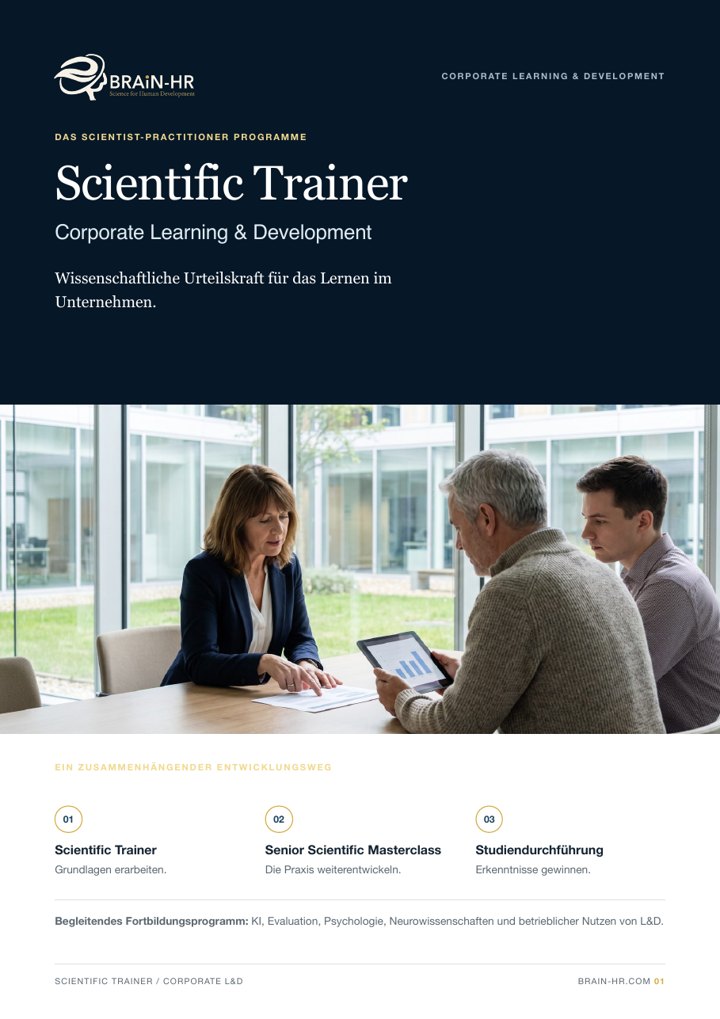
Scientific Trainer Corporate Learning & Development, 9 pages, PDF, 4.6 MB. For German-speaking teams and decision-makers.
Download the German brochureBefore we start
Yes. The qualification provides a defined starting point. The wider Scientist-Practitioner Programme adds ongoing Masterclass development, selected continuing education and, where needed, a commissioned study. These components can be planned together.
The standard Masterclass includes scientific guidance and one supported pilot up to an initial trial data collection. Full study implementation is a separate research work package. Its methods, deliverables, responsibilities and price are agreed in advance.
The work starts with your learning environment and approved tools. We agree the materials, access requirements and data handling during scoping. Technical integration or software development can be specified where needed.
The Scientific Trainer produces a presented and reviewed learning concept with an evaluation plan. The Masterclass supports its continued development. A commissioned study adds the data, analysis and report specified in the research agreement.
Individual participants can explore the open Scientific Trainer programme, including current dates, fees and booking options.
Bring one learning challenge, the roles you want to develop and the evidence you need for your next decision.
Dr. Franz Hütter · BRAIN-HR
fh@brain-hr.com