SNP BROWSER · RESEARCH USE ONLY (RUO) · EXCLUSIVELY FOR QUALIFIED SCIENTIFIC RESEARCH PERSONNEL
The calibrated local research workbench for genomics, pharmacogenomics, and cohort polygenic scores.
Researchers working with 80-gigabyte sequencing files previously had to chain together six separate command-line tools for alignment streaming, coordinate liftover, haplotype phasing, polygenic scoring, and literature curation. The SNP Browser unites this entire pipeline in a single, deterministically calibrated research workbench, natively on macOS or as a self-contained on-premise container without any data egress (Zero-Egress).
- ✓In-place htslib byte-range streaming for 80 GB BAM/CRAM/VCF without file copying, 289 loci on GRCh37, GRCh38, and rCRS mtDNA calibrated base by base against NIST-GIAB reference genomes
- ✓28 curated specialist panels, 46 pharmacogenes (CPIC/PharmVar), 40 multi-locus composite rules (diplotypes, phase ambiguities, mtDNA heteroplasmy) plus local ClinVar & ACMG scanner
- ✓Integrated plink2 pipeline on 1000 Genomes reference data (Missing != Wildtype), zero-PII literature federation across 4 databases & AES-256-GCM encrypted research dossier
Executive Overview (2:20 min): Analyze 80 GB BAM/CRAM and VCF files via in-place htslib byte-range streaming 100% locally inside your institute network, featuring 289 NIST-GIAB-calibrated loci, 28 specialist panels, 46 pharmacogenes, plink2 pipeline, and zero-PII literature federation (Exclusively for Research Use Only / RUO).
WHY NOT A FRAGMENTED SCRIPT CHAIN? · TECHNICAL & SCIENTIFIC PRECISION (RUO)
Why genomics research requires a deterministically calibrated, locally air-gapped workbench.
In the scientific evaluation of large sequencing and microarray datasets, unnoticed reference build switches, minor reference alleles, left-anchored deletions, or equating missing calls with the wildtype lead to systematic distortion. The SNP Browser locks these error classes technically inside the C/Python compute kernel.
289 loci on GRCh37, GRCh38 & rCRS mtDNA calibrated against NIST-GIAB
Every one of the 289 curated loci is validated base by base against official NIST-GIAB reference genomes (HG001 to HG007) and the CDC GeT-RM reference panel. Minor reference alleles, strand orientations, and indel normalizations are deterministically locked.
80 GB BAM/CRAM files and multi-sample cohorts in seconds
Via local htslib byte-range streaming, the workbench accesses requested genomic intervals directly in place and makes every call verifiable down to individual sequencing reads in the integrated IGV Pileup Viewer. For polygenic scores, an integrated plink2 pipeline computes on HGDP/1000 Genomes reference data down to machine precision.
Curated rsID extraction and encrypted research documentation
Search PubMed, Europe PMC, OpenAlex, and Crossref simultaneously without genotype egress, adopt verified rsIDs directly into custom research panels, and document cohort and laboratory metadata inside a client-side AES-256-GCM encrypted research dossier.
WHO IT IS BUILT FOR
Exclusively licensed for demonstrably qualified personnel in scientific research (RUO).
University & Non-University Genomics Research Groups
Analyze WGS/WES BAM, CRAM, VCF, and microarray datasets on macOS or inside an air-gapped institutional container with complete reproducibility across all reference builds.
Pharmacogenomic & Systems Biology Research
Investigate 28 curated specialist panels, 46 pharmacogenes (CPIC/PharmVar/DPWG), and 40 multi-locus composite rules including diplotype resolution, phase ambiguities, and mitochondrial heteroplasmy.
Epidemiological Cohort & Biobank Projects
Compute standardized Polygenic Scores (PGS/PRS) on single samples and multi-sample cohorts with HGDP/1kGP ancestry calibration and strict separation between uncovered loci and homozygous reference status (Missing != Wildtype).
HOW IT ACCELERATES YOUR WORK
Six core modules of the scientific research workbench.
Provided as a native macOS desktop application and as a fully self-contained on-premise container for institutional research infrastructures (Research Use Only).
In-place htslib byte-range streaming & integrated Pileup Viewer
Analyzes 80-gigabyte BAM, CRAM, and VCF files directly in place via local indices. Every genotype call remains verifiable with read depth (DP), mapping quality (MQ), and base quality (BQ) in the integrated IGV Pileup Viewer.
289 NIST-GIAB-calibrated loci across GRCh37, GRCh38, and rCRS mtDNA
Three-tier calibration architecture with 100% concordance across 624 analytical benchmark decisions on official NIST-GIAB and CDC GeT-RM reference samples; locks minor reference alleles, build drift, and left-anchored deletions.
28 specialist panels, 46 pharmacogenes & 40 multi-locus composite rules
Deterministic resolution of star alleles, diplotypes, phase ambiguities, and mtDNA heteroplasmy following CPIC, PharmVar, and DPWG nomenclature, complemented by a local ClinVar and ACMG Secondary Findings v3.2 research scanner.
Integrated plink2 pipeline for Polygenic Scores (PGS / PRS)
Computes PGS Catalog models on single samples and multi-sample cohorts against HGDP/1000 Genomes reference distributions down to machine precision (r = 1.000000) and explicitly reports missing loci (Missing != Wildtype).
Zero-PII literature federation with automated rsID extraction
Simultaneously queries PubMed, Europe PMC, OpenAlex, and Crossref without transmitting genetic data, extracts verified rsIDs with PMID/DOI from full texts or abstracts, and saves them per click as a custom research panel.
Client-side AES-256-GCM encrypted research dossier
Links resolved genotype, diplotype, and PGS vectors locally with structured phenotype and laboratory metadata, including a complete cryptographic audit trail of all reference and catalog versions used.
INSIDE THE APPLICATION
Inside the local RUO research workbench.
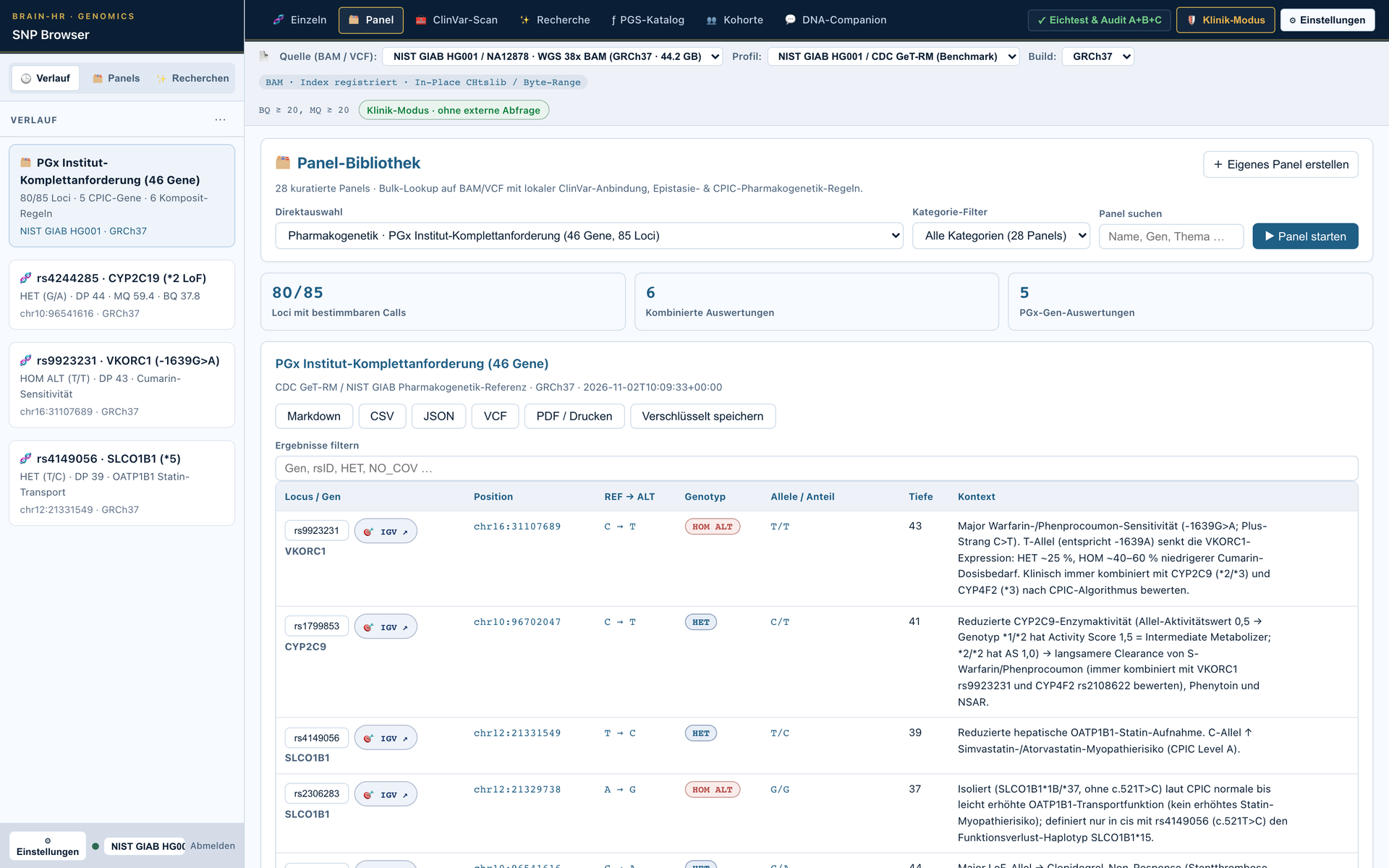
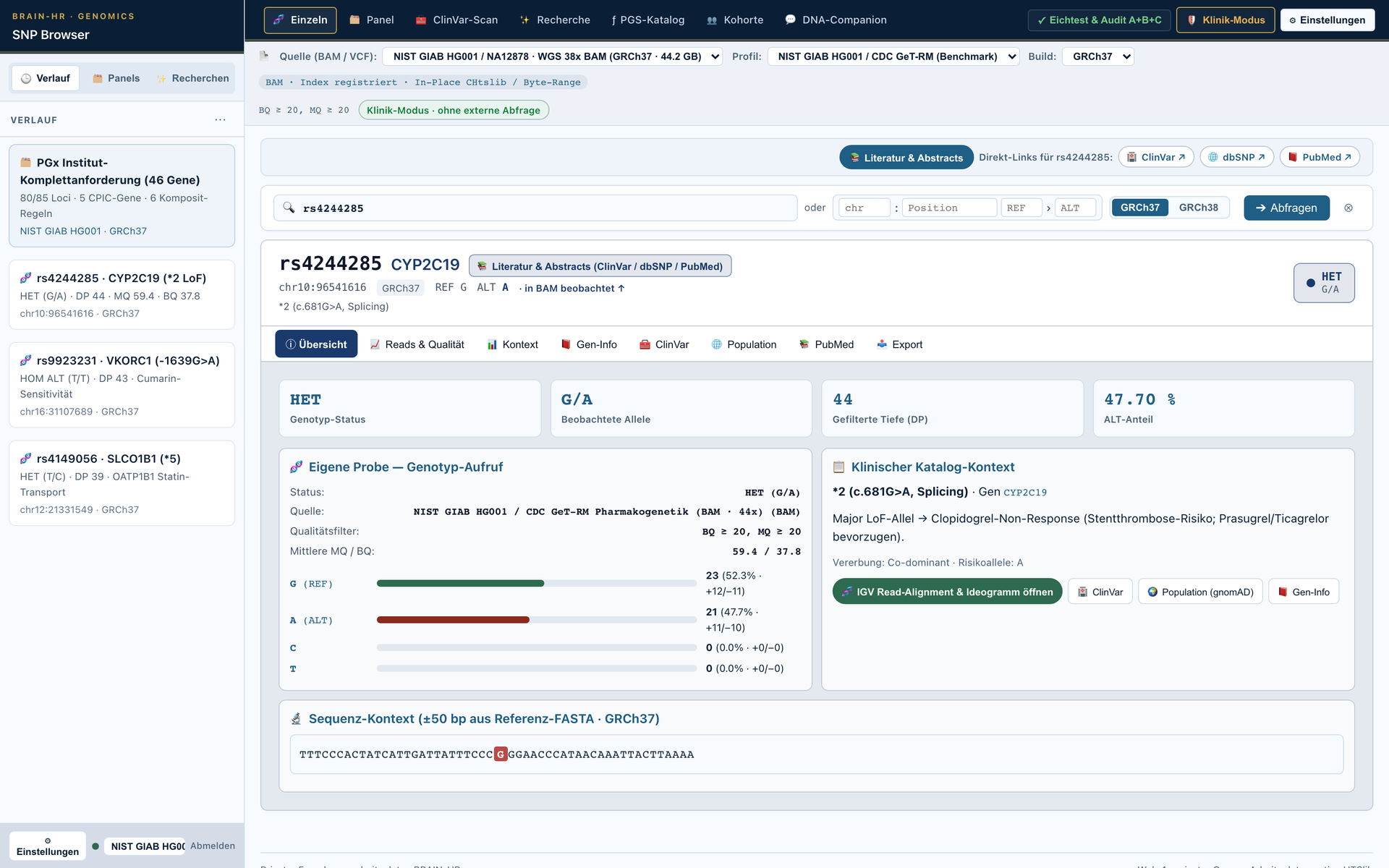
RESEARCH USE ONLY (RUO) · INSTITUTIONAL & RESEARCH LICENSING
Exclusively licensed for demonstrably qualified personnel in scientific research.
The SNP Browser is a scientific research workbench (Research Use Only, RUO) and not an in-vitro diagnostic device. Provisioning as a macOS workbench or self-contained on-premise container is restricted exclusively to research institutions, universities, and qualified scientific personnel.
Activation and container provisioning follow verification of the scientific research purpose (RUO) during a personal onboarding call.
QUALITY GUARANTEE & METHODOLOGY
Deterministic calibration against international reference genomes.
All computations in the SNP Browser are verified against public gold-standard reference samples (NIST GIAB & CDC GeT-RM) and engineered for completely air-gapped operation inside your institute network.
- Technically enforced Zero-Egress operation: All analyses on BAM, CRAM, VCF, and microarray files run 100% locally on your own hardware; not a single genotype byte ever leaves your institute network.
- 100% concordance in NIST-GIAB & GeT-RM calibration benchmarks: 624 out of 624 analytical benchmark decisions on official NIST-GIAB (HG001–HG007) and CDC GeT-RM reference samples are 100% concordant.
- Strict separation: Missing != Wildtype: Uncovered genomic positions (no-calls) are never silently imputed as homozygous reference genotypes (0/0), but reported as an explicit coverage metric.
- Research Use Only (EU-IVDR / MDCG 2019-11 / GenDG): Strict intended purpose as a scientific research workbench; excluded from clinical primary diagnostics, therapeutic decision-making, or direct-to-consumer self-testing.
For Methodology Leads & IT: Expand technical specifications and verification standards
IMPORTANT OPERATIONAL & REGULATORY NOTICES
- Important regulatory notice (Research Use Only, RUO): The SNP Browser is intended exclusively for scientific research by demonstrably qualified personnel. It is not a medical device and not an in-vitro diagnostic medical device within the meaning of Regulation (EU) 2017/746 (IVDR) and must not be used for diagnostic or therapeutic purposes in humans.
- All analyses take place locally on your system. Licensing requires verification of scientific qualification.
Schedule your 25-minute architecture and benchmark demonstration (RUO).
We demonstrate the workbench live on official NIST-GIAB and CDC GeT-RM reference genomes and discuss deployment in your research environment.
Schedule a personal live demo →OTHER TOOLS IN THE BRAIN-HR SUITE